Written by: Brianna Miles, Bowley Scholar, 2025-26
Have you ever looked back on old pictures of yourself? You can see how you have grown and changed over the years. The same can be said even before photography existed. So, if you lived in that time, you may know the names of important people like the president and congressmen…but how exactly do you know what they look like if you don’t live by them or know them personally? Portraits and engravings!
This is all well and good, but how does this pertain to James Monroe?
James Monroe is a prolific figure in American history who accomplished a lot in his lifetime, from being a veteran of the Revolutionary War, a Minister to France and Great Britain, the fifth President of the United States, to declaring the Monroe Doctrine. But what did he look like? There are more than a dozen different depictions of James Monroe in different mediums: portraiture, engravings of portraits, silhouettes, busts, statues, and peace medals. Some of these depictions were made by very well-known artists in Monroe’s day, such as Charles Bird King, Charles Willson Peale, Rembrandt Peale, John Vanderlyn, Felix Sharples, Thomas Gimbrede, possibly Bass Otis, and Gilbert Stewart, along with various artists even well after his death.
OK. So we know what he looks like, big deal, we know what other presidents look like, too! Just look at Thomas Jefferson or George Washington!
While this is true, in the past, a lot of people didn’t know what major public figures looked like unless they saw them in person. They didn’t have instant access to images like we do now. You may have been able to see one if you were invited into a household like the Madison’s, who had a portrait of Monroe, but that was not the case for most people.
The depictions of Monroe discussed in this blog range from when he was minister to France–or before, if you include John Trumbull’s paintings of The Battle of Trenton and Washington Crossing the Delaware–to after his death in 1831. One interesting thing about the depictions of James Monroe is that he is not just a static character or caricature throughout every representation, though there are certainly things that help point out that it is indeed him.
One of the earliest images of James Monroe is from 1796 during his time as Minister to France. He and his family embraced French culture and were well known for it, leading them to commission portraits from a lesser-known Swiss artist working in France by the name of Louis Sené.

Due to this being well before some of the later portraits, there are some discrepancies in his likeness, but in context, that is to be expected. Not to mention he was only 38 at the time, though he does look a good deal younger. Like a lot of the representations of Monroe, there is very little record of his opinion on his appearance in portraits; however, there is a record of his fondness for the miniature of his wife by Sené. Miniatures like this were small portraits meant for private use, kind of like a wallet photo today, except hand-painted. Like some other images of Monroe, this miniature was passed down through the family.
A lot of the depictions of James Monroe are created around when he was inaugurated as the fifth President, March 4, 1817. Remember how most people had no idea what he looked like? Well, this was a transitional period with early American prints and their appearance in newspapers. Before, there were very few prints, especially of recognizable people, circulating in the public sphere unless it was perhaps George Washington. But with the presidency of James Monroe, paintings were commissioned to be made into prints to be circulated. One example of this is Charles Bird King’s portrait, which was commissioned by William Morgan in honor of Monroe’s 1817 inauguration.
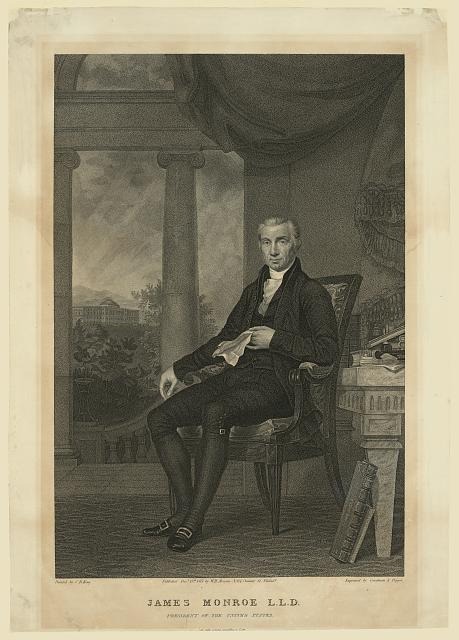
New technology was developing, and so the price of making prints wasn’t as expensive as it was before, which meant that as images were circulated through the newspapers, more people were able to see what Monroe looked like. There is actually an anecdote featured in two separate newspapers in 1817–one from the Newburyport Herald, August 6, 1817, and one from the Albany (New York) Argus, August 22, 1817–that shows the result of that distribution. Whether this interaction happened or not, it exemplifies the sentiment:
“A few days after the arrival of Mr. Monroe in Boston, he went out early one morning in his carriage to sit for his portrait to Mr. Stuart. Not knowing his dwelling, he stopped a country man seated on his cart and enquired for Mr. Stuart’s house. The country man looked steadfastly at him. “It is the President, I vow,” said he to himself, and, instinctively taking off his hat, he gave three loud and hearty cheers, and drove off, leaving the president unanswered and astonished.”
During the last full year of his presidency in 1824-1825, there was a painting by Rembrandt Peale, son of Charles Willson Peale, who also painted James Monroe years before.
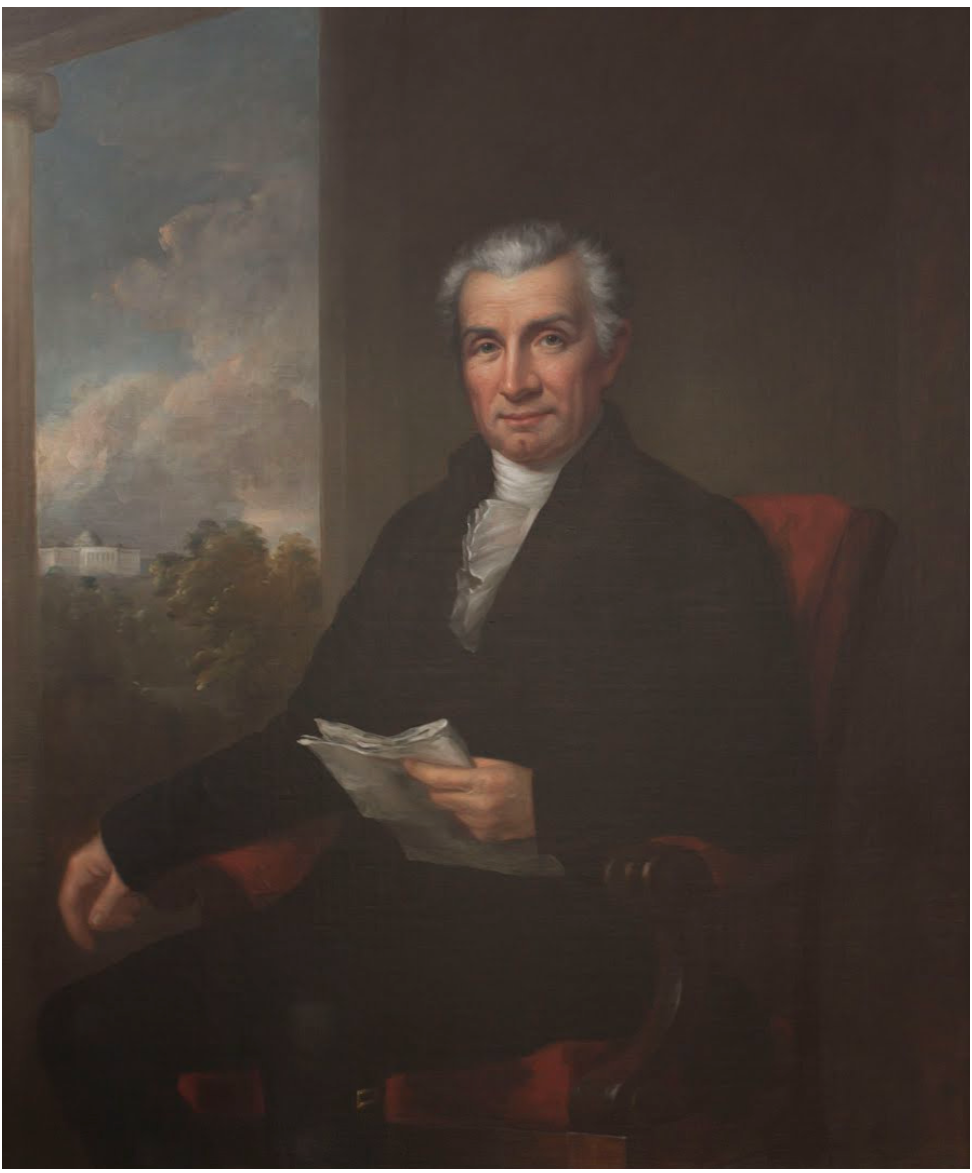
This painting actually looks quite similar to Charles Bird King’s portrait, which the Goodman and Piggot engraving is based on; however, there are differences. Peale’s representation is more focused on Monroe as the subject, showing him as an embodiment of the country, with the Capitol sitting next to him, even while in the background. It is not known if he actually sat for this portrait, or if Peale, who was close with King, based it on his work, since it was made seven years later. Either way, the painting exemplifies some of the consistencies between most depictions of James Monroe, such as his facial features and the way he always wore quite antiquated dress, for which he is known to be called “the last of the cocked hats.”
Not even death stopped the depictions of James Monroe, who died on July 4, 1831. There were a few works of art commemorating him, but none showed his likeness by himself, except the death mask made by John Henri Isaac Browere before Monroe was interred in New York.

James Monroe was one of the few famous figures from whom he was not able to get a life mask, so he made a death mask instead. This mask shows what he looked like at 73 years old. You can still see the distinct features in his face, the wrinkles and all. It is possibly one of the most accurate depictions due to it being literally molded on his face. It’s like putting your hand in wet cement or, in this case, plaster.
Cool, more people can see what he looked like. But why do we need to see them in the first place?
James Monroe was a symbol of hope for a better future in the United States through national unity, especially during his presidency, which was, at the start, called the “Era of Good Feelings.” Images have power just as a symbol can; put them together, and it can influence how people act and think about certain topics. James Monroe continued to be an influential figure even after his death, and so the depictions of him were still in demand, especially in the 1850s and 60s, when there was a heightening of interest in Virginia’s history and heroes.
Even into the early 20th century and beyond, representations of him continued to be made. Just take the bas relief Signing of the Louisiana Purchase Treaty by Karl Bitter (1903/1904), for example.
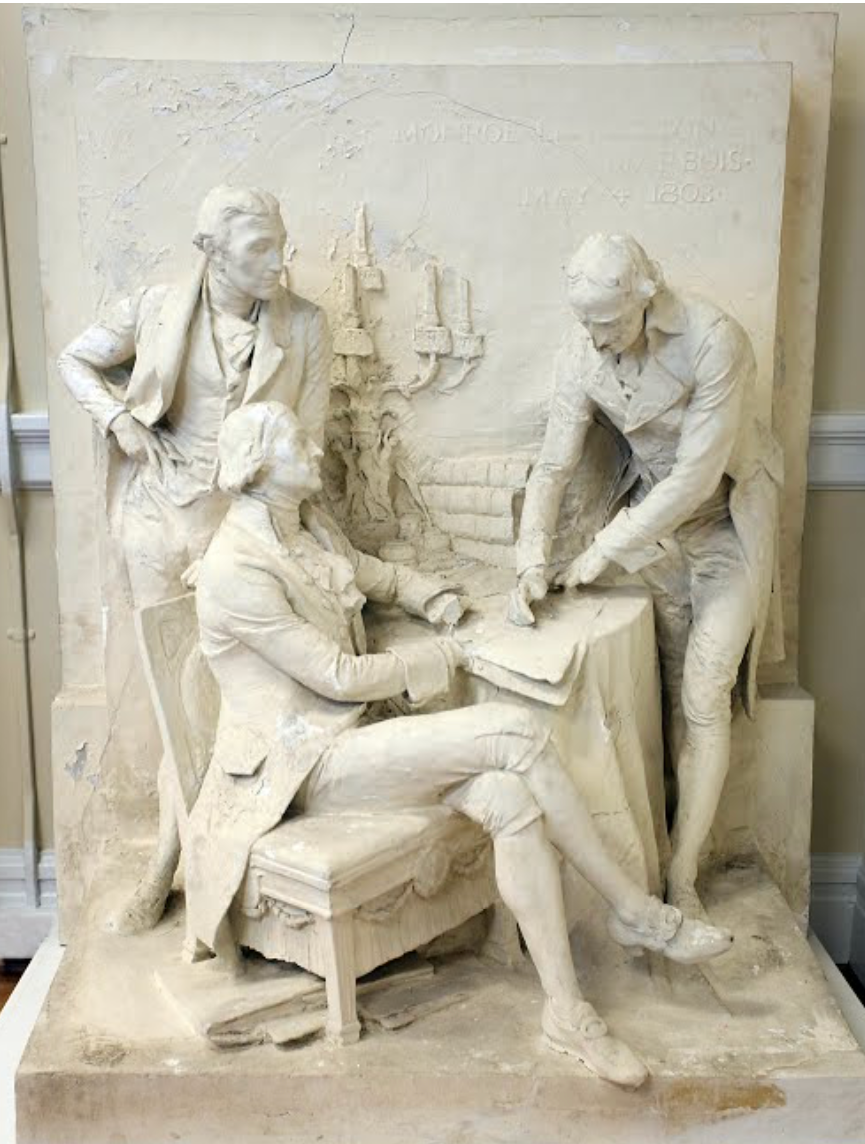
It was a model for the larger sculpture created for the St. Louis World’s Fair, celebrating the Louisiana Purchase of 1803. The influence of James Monroe, even a hundred years later, persisted. It is an interesting representation due to the fact it is in sculptural form, of which there were not many before this was made.
So, not only do these different images of James Monroe show us what the fifth president of the United States looked like, but they also give so much more information about Monroe himself and what the country was like at the time they were made.
Bibliography:
Cosentino, Andrew J, Charles Bird King, and National Collection of Fine Arts. The Paintings of Charles Bird King (1785-1862). Washington: Published for the National Collection of Fine Arts by the Smithsonian Institution Press : for sale by the Supt. of Docs., U.S. Govt. Print. Off., 1977.
Dunlap, William. A History of the Rise and Progress of the Arts of Design in the United States, by William Dunlap… Boston: C.E. Goodspeed & co., 1918.
Langston-Harrison, Lee, David Meschutt, and John N Pearce. Images of a President : Portraits of James Monroe. Fredericksburg, Va: James Monroe Museum and Memorial Library, 1992.
Meschutt, David Randolph. “The Portraiture of James Monroe, 1758–1831.” Order No. 3200555, University of Delaware, 2006. https://umw.idm.oclc.org/login?url=https://www.proquest.com/dissertations-theses/portraiture-james-monroe-1758-1831/docview/305322695/se-2.
Notes from the James Monroe Museum archives
Park, Lawrence, John Hill Morgan, and Royal Cortissoz. Gilbert Stuart; an Illustrated Descriptive List of His Works. New York: W.E. Rudge, 1926.
Remarks On The Early American Engravings And The Cambridge Press Imprints, 1640-1692, In The Library Of The American Antiquarian SocietyStagg, Allison M. Prints of a New Kind : Political Caricature in the United States, 1789-1828. University Park, Pennsylvania: The Pennsylvania State University Press, 2023.
You must be logged in to post a comment.